The Museum's airplane was obtained
from the British Columbia Institute of Technology in Vancouver, B.C. on
a long-term lease agreement. Like many other Canadian aviation
institutions, the Museum has had an on-going excellent relationship
with the B.C.I.T.
The airplane was originally delivered to the BCIT 20 August 1982.
The pilot was Ray Goudey, pilot of the first flight 25 years
before. On board for the last flights, from Burbank to the
Abbottsford, B.C. Airshow, and then on to Vancouver International, was
Kelly Johnson, designer and retired head of the famed Lockheed Skunk
Works. During the short hop from Abbottsford to YVR, the airplane
performed between 3 and 6 aileron rolls, a maneuver Ray loved to do in
N329J.
Donation of this airplane to the BCIT was part of an 'offset' agreement
between Lockheed and the Canadian government tied to the purchase of
CP-140 Aurora maritime patrol airplanes (Canadian version of P-3 Orion.)
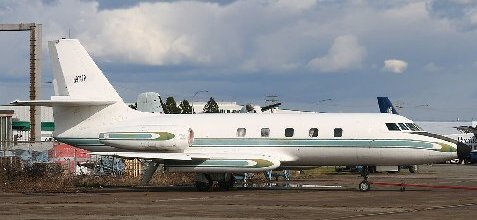
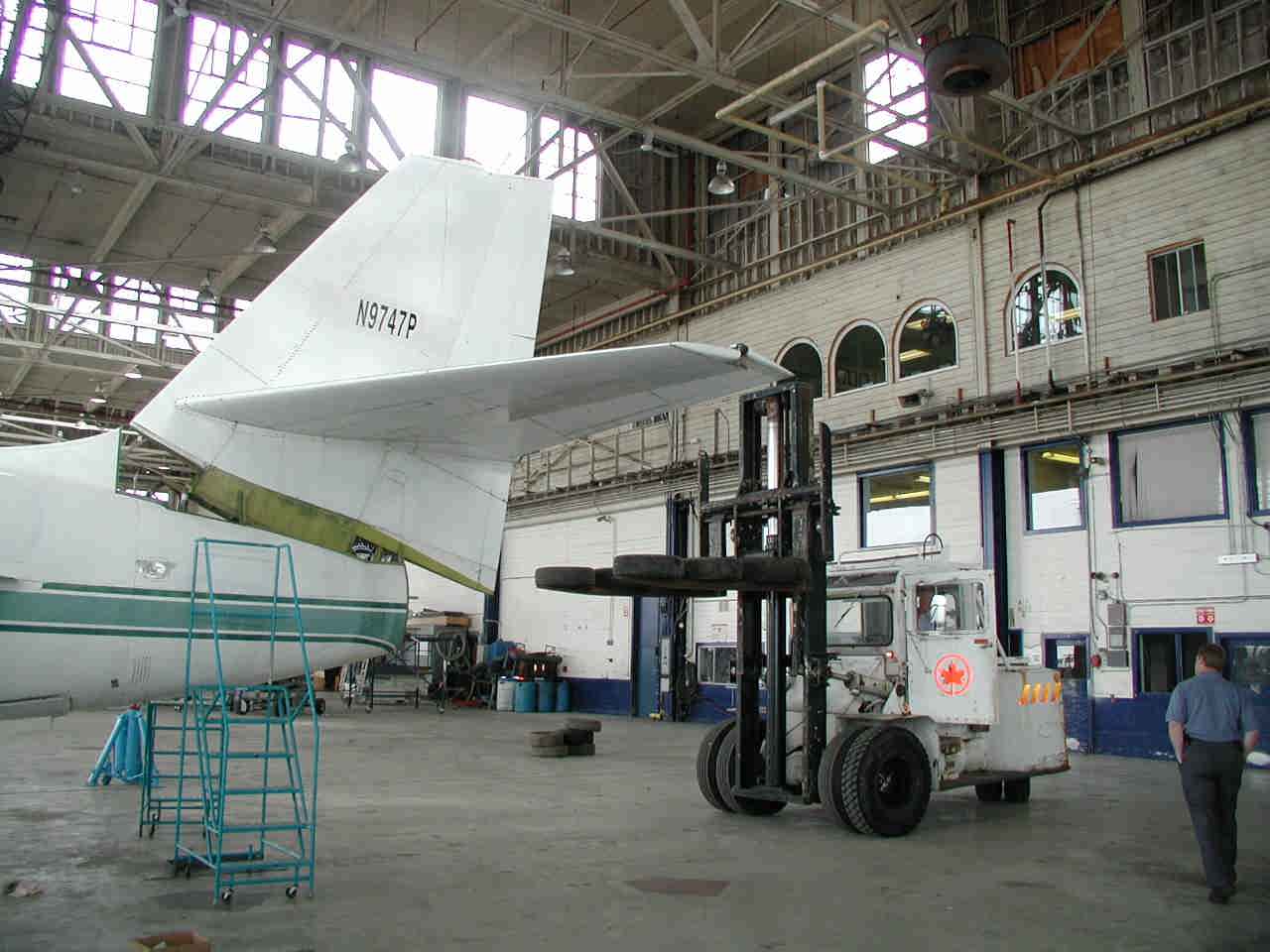
Disassembly at B.C.I.T. The registration, N9747P, is not an
active registration on the U.S. Registry, and is believed to have been
applied for filming of a movie.
The airplane was moved from the Vancouver
International Airport (CYVR) to Paine Field (KPAE) in Everett,
Washington, on 28 April 2006.
The Jetstar was delivered to BCIT on 20 August 1982. Total time on the airframe is
2,479 hrs. Power is provided by two Bristol Siddley Orpheus 810D turbojets rated
at 4,850 lbs thrust. Left engine has 136 hours, right engine is 640. The
fuselage is equipped with an electronics bay for the telemetry equipment that was
installed for the chase plane assignments on the SR-71 program.

 Waiting at the border..........
 Arrival at Paine Field 28 April 2006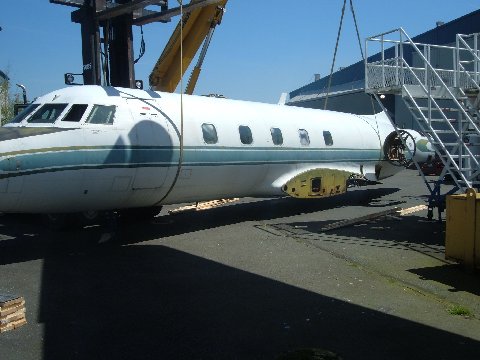

 Wings and engines
 Arrival of the tail assembly -- 12 May 2006
 In new temporary home -- More Photos Here