A First Hand Doolittle story.....
Mesmerizing....
and sobering
Indeed - the Greatest Generation.

My name is
Edgar McElroy. My friends call me
"Mac". I was born
and
raised in Ennis, Texas the youngest of five
children, son of Harry
and Jennie McElroy. Folks say that I was
the
quiet
one. We lived at 609 North Dallas Street and
attended the
Presbyterian Church.
My dad had an auto mechanic's
shop downtown
close to
the main fire station. My family was a
hard-working
bunch, and I was
expected to work at dad's garage
after school and
on Saturdays, so I
grew up in an
atmosphere of
machinery, oil and grease.
Occasionally
I would hear a
lone plane fly over, and would run out
in the street
and strain my eyes against the sun to
watch it.
Someday, that would be me up there!
I really
like cars and I was
always busy on some
project. It wasn't long
before I
decided to build my very own
Model-T
out of spare
parts. I got an engine from over here, a
frame
from
over there, and wheels from someplace
else, using
only the
good parts from old cars that were
otherwise shot.
It wasn't very
pretty but it was all
mine. I enjoyed
driving on the dirt roads
around town and the
feeling of
freedom and speed. That car of mine
could
really go fast, 40
miles per hour!
In high school I played
football and tennis and
was
good enough at football to receive an athletic
scholarship
from
Trinity University in Waxahachie. I have
to admit that
sometimes I
daydreamed in class and, often times, I
thought about
flying my very
own airplane and being up there in
the clouds. That
is when I even
decided to take a correspondence
course in aircraft
engines.
Whenever I got the chance, I would take
my girl on a
date up to Love Field in Dallas . We
would watch the
airplanes and
listen to those mighty piston engines
roar. I just
loved it and if she
didn't, well that was just too
bad.
After my
schooling, I
operated a filling station with
my brother, then
drove a bus, and
later had a job as a machinist in
Longview but I
never lost my
love of airplanes and my dream of flying.
With what was
going on in Europe and in Asia, I figured that our
country would
be drawn into war someday so I decided
to join the
Army
Air Corps in November of 1940. This way I could
finally follow
my
dream.
I reported for primary training
in California .
The
training was rigorous and frustrating at times.
We trained at
airfields all over California. It was tough going
and many of the
guys washed out. When I finally saw that
I was going to
make it, I
wrote to my girl back in Longview ,
Texas. Her name is
Agnes Gill. I
asked her to come out to
California for my
graduation. And ,oh yeah,
also to marry
me.
I graduated on
July 11, 1941. I
was now a real,
honest-to-goodness Army Air Corps
pilot. Two
days later, I married
"Aggie" in Reno, Nevada
. We
were starting a new life together and
were
very happy. I
received my orders to report to Pendleton, Oregon
and join the
17th Bomb Group. Neither of us had
traveled much
before,
and the drive north through the Cascade Range of
the
Sierra
Nevada was interesting and beautiful.
It was an
exciting time for
us. My unit was the first
to receive the new B-25
medium bomber.
When I saw it for the first
time I was in
awe. It looked so
huge. It was so sleek and powerful.
The
guys started
calling it the "rocket plane" and I could
hardly
wait to get my hands on it. I told Aggie that
it was really
something!
Reminded me of a big old scorpion
just ready to
sting! Man, I could
barely
wait!
We
were
transferred to another airfield in Washington
State
where we spent
a lot a time flying practice missions and
attacking
imaginary targets. Then, there were other
assignments in
Mississippi
and Georgia for more maneuvers and more practice.
We
were on our way
back to California on December 7th
when we got word
of a Japanese
attack on Pearl Harbor . We listened
with mixed
emotions to the
announcements on the radio and the next day
to the
declaration of
war. What the president said just rang over and
over in my head,
"With confidence in our armed forces, with the
unbounding
determination of our people, we will gain the
inevitable
triumph,
so help us God." By gosh, I felt as though he
was talking
straight to me! I didn't know what
would happen to us,
but we all
knew that we would be going somewhere
now.
The
first weeks of
the war, we were back in Oregon
flying patrols at
sea looking for
possible Japanese submarines. We
had to be up
at 0330 hours
to warm up the engines of our planes. There
was 18
inches of
snow on the ground and it was so cold that our
engine oil
congealed overnight. We placed big tarps over the
engines
that
reached down to the ground. Inside this tent we used
plumbers
blow
torches to thaw out the engines. I figured that my
dad would be
proud of me if he could see me inside this tent with
all this
machinery, oil, and grease. After about an
hour of this, the
engines
were warm enough to start.
We flew patrols over the
coasts of Oregon
and
Washington from dawn until dusk. Once,
I thought I
spotted a sub and
started my bomb run, even had my
bomb
doors open, but I pulled out
of it when I
realized that it
was just a big whale.
Lucky for me, I
would have
never heard the end of that!
Actually, it was
lucky for us that
the Japanese didn't
attack the West Coast
because we just
didn't have a strong enough
force to beat them off.
Our country
was in a real fix now and,
overall, things looked
pretty bleak to
most folks. In early February,
we were ordered to
report to
Columbus, South Carolina. Man, this Air
Corps
sure moves a
fellow around a lot! Little did I know what
was
coming next!
After we
got settled in Columbus, my squadron
commander
called us all
together. He told us that an awfully
hazardous mission was
being planned and then he asked for
volunteers.
There were
some of the guys who did not step forward but I was
one of
the
ones who did. My co-pilot was shocked.
He said "You
can't
volunteer, Mac! You're married and you
and Aggie are
expecting a
baby soon. Don't do it!" I told
him that,
"I got into the Air Force
to do what I can,
and
Aggie understands how I feel. The war won't
be
easy for any
of us."
We who volunteered were
transferred to Eglin
Field
near Valparaiso, Florida in late
February. When we all
got together,
there were about 140 of us volunteers.
We were told
that we were now
part of the "Special B-25
Project".
We set about our training but none of
us knew what it
was all about. We were ordered not to talk about it,
not even to
our
wives.
In early March, we were all
called in
for a briefing
and gathered together in a big
building there on
the base. Somebody
said that the fellow who's
the head of
this thing is coming to talk to
us and in walks
Lieutenant Colonel
Jimmy Doolittle. He was already an
aviation legend
and there he
stood right in front of us. I was truly
amazed just
to meet him.

Colonel Doolittle explained that this mission would
be
extremely
dangerous and that only volunteers could take part.
He said
that
he could not tell us where we were going but he
could say that
some of us would not be coming back.
There was a
silent pause; you could have heard a pin
drop. Then
Doolittle said
that anyone of us could withdraw now, and
that no one would
criticize us for this decision. No one backed
out!
From the
outset, all volunteers worked from the early morning
hours
until
well after sunset. All excess weight was stripped
from the
planes
and extra gas tanks were added. The lower gun turret
was
removed,
the heavy liaison radio was removed, and then the
tail guns
were
taken out and more gas tanks were put aboard. We
extended the
range of that plane from 1000 miles out to 2500
miles.
Then
I
was assigned my crew. There was Richard
Knobloch
the co-pilot,
Clayton Campbell the navigator, Robert
Bourgeous the
bombardier, Adam Williams the flight engineer and
gunner, and me,
Mac McElroy the pilot. Over the coming days, I came
to
respect
them a lot. They were a swell bunch of guys, just
regular
All-American boys.
We got a few ideas from
the training as
to what type
of mission that we had signed on for.
A Navy pilot
had joined our
group to coach us at short takeoffs
and also in
shipboard etiquette.
We began our short
takeoff practice.
Taking off with first a light
load, then a normal
load, and finally
overloaded up to 31,000 lbs. The
shortest possible
take-off was
obtained with flaps full down,
stabilizer set
three-fourths,
tail heavy, full power against the
brakes and
releasing the brakes
simultaneously as the engines revved
up
to max power.
We pulled back gradually on the stick and the
airplane left the
ground with the tail skid about one foot from the
runway. It was a
very unnatural and scary way to get
airborne! I
could
hardly believe it myself, the first time as I took
off with a
full
gas load and dummy bombs in just 700 feet of runway
in a near
stall
condition. We were, for all practical purposes, a
slow-flying
gasoline bomb!
In addition to take-off practice, we
refined our
skills in day and night navigation, gunnery,
bombing, and low level
flying. We made cross country flights at
tree-top level, night
flights and navigational flights over the Gulf of
Mexico without
the
use of a radio. After we started that
short-field
takeoff routine, we
had some pretty fancy
competition between the
crews. I think that one
crew got it down to about
300 feet on a
hot day. We were told that
only the best
crews would
actually go on the mission and the rest
would be
held in reserve.
One crew did stall on takeoff, slipped back
to the
ground, busting
up the landing gear. They were eliminated from
the
mission.
Doolittle emphasized again and again the extreme
danger
of this
operation and made it clear that anyone who so
desired could
drop
out with no questions asked. No one did.
On
one of our cross
country flights, we landed at
Barksdale Field in
Shreveport and I
was able to catch a bus over to
Longview to see
Aggie. We had a
few hours together and then we had to
say our
goodbyes. I told her
I hoped to be back in time for the baby's
birth but
I couldn't
tell her where I was going. As I walked away,
I
turned and
walked backwards for a ways taking one last look at
my
beautiful,
pregnant Aggie.
Within a few days of
returning to our base
in
Florida, we were abruptly told to pack our
things. After
just three
weeks of practice, we were on our
way. This
was it. It was time to
go. It was the middle
of March 1942
and I was 30 years old. Our
orders were to fly to
McClellan Air
Base in Sacramento, California on
our own, at the
lowest possible
level. So here we went on our way
west, scraping
the tree
tops at 160 miles per hour and skimming
along
just 50 feet
above plowed fields. We crossed north Texas and
then the
panhandle, scaring the dickens out of livestock,
buzzing farm
houses
and a many a barn along the way. Over the Rocky
Mountains and
across the Mojave Desert dodging
thunderstorms, we enjoyed the
flight
immensely and, although tempted, I didn't do
too much
dare-devil
stuff. We didn't know it at the
time but it was
good practice for
what lay ahead of us. It proved
to be our last
fling. Once we arrived
in Sacramento, the mechanics
went over our
plane with a fine-toothed
comb. Of the twenty-two
planes that made
it, only those whose pilots
reported no mechanical
problems were
allowed to go on. The others were
shunted aside.
After having our
plane serviced, we flew on to Alameda
Naval Air
Station in
Oakland. As I came in for final approach, we
saw
it! I
excitedly called the rest of the crew to take a
look. There
below
us was a huge aircraft carrier. It was the USS
Hornet, and it
looked so gigantic! Man, I had never even seen
a carrier until
this
moment. There were already two B-25s
parked on the
flight deck. Now
we knew! My heart was racing and I
thought about
how puny my plane
would look on board this mighty
ship. As soon as
we landed and taxied
off the runway, a jeep pulled
in front of me
with a big "Follow Me"
sign on the back. We
followed it straight up to the wharf alongside
the
towering
Hornet. All five of us were looking up and just in
awe,
scarcely
believing the size of this thing. As we left
the plane,
there was already a Navy work crew swarming around
attaching cables
to the lifting rings on top of the wings and the
fuselage. As we
walked toward our quarters, I looked back and
saw them lifting
my
plane up into the air and swing it over the
ship's deck.
It looked
so small and lonely.

Later
that afternoon,
all crews met with Colonel
Doolittle and he gave
last minute
assignments. He told me to go to
the Presidio and
pick up two
hundred extra "C" rations. I saluted,
turned, and
left,
not having any idea where the Presidio was and not
exactly sure
what a "C" ration was. I commandeered a Navy
staff
car
and told the driver to take me to the
Presidio and he
did. On the
way over, I realized that I had
no written
signed orders and that this
might get a little
sticky. So,
in I walked into the Army supply depot
and made my
request, trying
to look poised and confident. The supply
officer
asked,
"What is your authorization for this request,
sir?"
I
told him that I could not give him one.
"And what is
the
destination?" he asked. I answered, "The
aircraft carrier, Hornet,
docked at
Alameda." He
said, "Can you tell me who ordered the
rations,
sir?"
And I replied with a smile, "No, I cannot." The
supply
officers huddled together, talking and glanced back
over toward
me.
Then he walked back over and assured me that the
rations would
be
delivered that afternoon Guess they figured that
something big
was
up. They were right. The next morning, we all
boarded the
ship.

Trying to remember my naval etiquette, I
saluted the
Officer
of the Deck and said, "Lt. McElroy, requesting
permission
to
come aboard." The officer returned the salute
and said,
"Permission
granted." Then I turned aft and saluted
the
flag. I made it, without
messing up. It was April
2, and, in full
sunlight, we left San
Francisco Bay . The whole
task force of
ships, two cruisers, four
destroyers, and a fleet
oiler moved
slowly with us under the Golden
Gate Bridge .
Thousands of people
looked on. Many stopped their cars
on the bridge
and waved to us
as we passed underneath. I thought to
myself,
I hope there
aren't any spies up there waving.
Once at sea,
Doolittle called us
together. "Only a few
of you know our destination
and you
others have guessed about
various targets.
Gentlemen, your
target is Japan!" A sudden cheer
exploded
among the
men. "Specifically, Yokohama, Tokyo, Nagoya, Kobe,
Nagasaki,
and Osaka . The Navy task force will get us as
close as
possible and we'll launch our planes. We will hit
our targets and
proceed to airfields in China."
After the cheering
stopped, he asked
again if any of us desired
to back out, no
questions asked. Not one
did, not one. Then
the ship's
captain went over the intercom to the
whole ship's
company.
The loudspeaker blared, "The destination is
Tokyo!"
A tremendous cheer broke out from everyone on board.
I could
hear
metal banging together and wild screams from down
below decks.
It was quite a rush! I felt relieved actually.
We finally knew
where
we were going.
I set up quarters with
two Navy pilots
putting my cot
between their two bunks. They
couldn't get
out of bed without
stepping on me. It was just
fairly cozy in
there, yes it was. Those
guys were part of
the Torpedo
Squadron Eight and were just swell
fellows. The
rest of the guys
bedded down in similar fashion to me.
Some
had to sleep on
bedrolls in the Admiral's chart room. As big as
this ship was,
there wasn't any extra room anywhere. Every square
foot
had a
purpose. A few days later, we discovered
where they had
an ice
cream machine!
There were sixteen B-25s tied
down on the flight
deck
and I was flying number 13. All the
carrier's fighter
planes were
stored away helplessly in the hangar
deck. They
couldn't move until we
were gone. Our Army
mechanics were all on
board as well as our
munitions loaders and
several back
up crews in case any of us got
sick or backed
out. We
settled into a daily routine of checking our
planes. The aircraft
were grouped so closely together on deck that it
wouldn't take
much for them to get damaged. Knowing that my
life
depended
on this plane, I kept a close eye on her.
.jpg)
Day after
day, we met with
the intelligence officer
and studied our mission
plan. Our
targets were assigned, and maps and
objective
folders were
furnished for study. We went over approach
routes
and our escape
route towards China . I never studied this hard
back at Trinity.
Every day at dawn and at dusk, the ship was called
to
general
quarters and we practiced finding the
quickest way to
our
planes. If at any point along the
way, we were
discovered by the
enemy fleet, we were
to launch our
bombers immediately so the
Hornet could bring
up its
fighter planes. We would then be on our
own,
and try to make
it to the nearest land, either Hawaii or
Midway
Island.
Dr.
Thomas White, a
volunteer member of plane number 15, went over our
medical records
and gave us inoculations for a whole bunch of
diseases that hopefully
I wouldn't catch. He gave us training sessions in
emergency
first aid and lectured us at length about water
purification
and such. Tom, a medical doctor, had learned how to
be a gunner just
so he could go on this mission. We put
some new tail
guns in place of the ones that had been taken
out to save
weight. Not exactly functional, they were two
broom handles
painted black. The thinking was they might help
scare any Jap fighter
planes. Maybe, maybe not.
On Sunday, April 14, we
met up with
Admiral Bull Halsey's task force just out of Hawaii
and joined
into one big force. The carrier Enterprise was now
with us, another
two heavy cruisers, four more destroyers, and
another oiler. We were
designated as Task Force 16. It was quite an
impressive sight to see,
and represented the bulk of what was left of the
U.S. Navy after
the devastation of Pearl Harbor. There were
over 10,000 Navy
personnel sailing into harm's way, just to deliver
us sixteen Army
planes to the Japs, orders of the president.

As we
steamed further west,
tension was rising as we drew nearer and nearer to
Japan .
Someone thought of arming us with some old .45
pistols that they had
on board. I went through that box of 1911 pistols -
they were in such
bad condition that I took several of them apart,
using the good
parts from several useless guns until I built a
serviceable weapon.
Several of the other pilots did the
same. Admiring my
"new" pistol, I held it up, and thought about
my old
Model-T.
Colonel Doolittle called us together on the
flight deck. We
all gathered round, as well as many Navy
personnel. He pulled
out some medals and told us how these friendship
medals from the
Japanese government had been given to some of our
Navy officers
several years back. And now, the Secretary of
the Navy had
requested us to return them. Doolittle wired
them to a bomb
while we all posed for pictures. Something to cheer
up the folks
back home!
I began to pack my things for the flight
scheduled for the
19th. I packed some extra clothes and a little brown
bag that Aggie
had given me. Inside were some toilet items and a
few candy bars. No
letters or identity cards were allowed, only our dog
tags. I
went down to the wardroom to have some ice
cream and settle up
my mess bill. It only amounted to $5 a day and, with
my per diem of
$6 per day, I came out a little ahead. By now, my
Navy pilot
roommates were about ready to get rid of me
but I enjoyed my
time with them.
They were all right. Later on, I learned that
both of them were killed at the Battle of Midway.
They were good men.
Yes, very good men.
Colonel Doolittle let each crew pick
its own target.
We chose the Yokosuka Naval Base about twenty miles
from Tokyo. We
loaded 1450 rounds of ammo and four 500-pound
bombs. A little
payback, direct from Ellis County, Texas! We
checked and
re-checked our plane several times. Everything was
now ready. I felt
relaxed yet tensed up at the same time. Day after
tomorrow, we will
launch when we are 400 miles out. I lay in my cot
that night and
rehearsed the mission over and over in my head. It
was hard to sleep
as I listened to sounds of the ship.

Early the next
morning, I was
enjoying a leisurely breakfast, expecting another
full day on board,
and I noticed that the ship was pitching and rolling
quite a bit this
morning more than normal. I was reading
through the April 18th
day plan of the Hornet, there was a message in it
which said, "From
the Hornet to the Army - Good luck, good
hunting, and God bless
you." I still had a large lump in my
throat from
reading this when, all of a sudden, the intercom
blared, "General
Quarters, General Quarters, All hands man your
battle stations!
Army pilots, man your planes!" There was instant
reaction from
everyone in the room and food trays went crashing to
the floor. I ran
down to my room jumping through the hatches along
the way, grabbed my
bag, and ran as fast as I could go to the
flight deck. I met
with my crew at the plane, my heart was
pounding. Someone
said, "What's going on?" The word was that the
Enterprise
had spotted an enemy trawler. It had been
sunk, but it had
transmitted radio messages. We had been found out!
The
weather was
crummy, the seas were running heavy, and the ship
was pitching up and
down like I had never seen before. Great waves
were crashing
against the bow and washing over the front of the
deck.
This wasn't going to be easy! Last minute
instructions were
given. We were reminded to avoid non-military
targets,
especially the Emperor's Palace. Do not fly to
Russia, but
fly as far west as possible, land on the water
and launch our
rubber rafts. This was going to be a one-way
trip! We were still
much too far out and we all knew that our chances of
making land
were somewhere between slim and none.
Then at the last
minute, each plane loaded an extra ten 5-gallon gas
cans to give us a
fighting chance of reaching China.
We
all climbed aboard, started our engines and warmed
them
up, just feet away from the plane in front of us and
the plane
behind
us. Knobby, Campbell, Bourgeois, and me in the
front, Williams,
the
gunner was in the back separated from us by a big
rubber gas tank.
I
called back to Williams on the intercom and told him
to look sharp
and
don't take a nap! He answered dryly, "Don't
worry about
me,
Lieutenant.
If they jump us, I'll just use my little black
broomsticks
to
keep the Japs off our tail."
The
ship headed into the wind and picked up speed. There
was now a near
gale force wind and water spray coming straight over
the deck. I
looked down at my instruments as my engines revved
up. My mind was
racing. I went over my mental checklist and said a
prayer. God
please, help us!
Past
the twelve planes in front of us, I strained to see
the flight deck
officer as he leaned into the wind and signaled with
his arms
for Colonel Doolittle to come to full power. I
looked over at Knobby
and we looked each other in the eye. He just nodded
to me and we
both understood.
With the deck heaving up and down, the
deck officer had
to time this just right. Then I saw him wave
Doolittle to go,
and we watched breathlessly to see what happened.
When his plane
pulled up above the deck, Knobby just let out
with, "Yes!
Yes!"


The second plane, piloted by Lt.
Hoover, appeared to stall
with its nose up and began falling toward the waves.
We groaned and
called out, "Up! Up! Pull it up!"
Finally,
he pulled out of it, staggering back up into the
air, much to our
relief! One by one, the planes in front of us
took off. The
deck pitched wildly 60 feet or more, it looked like.
One plane seemed
to drop down into the drink and disappeared for a
moment, then pulled
back up into sight. There was sense of relief
with each one
that made it.
We
gunned our engines and started to roll
forward. Off to the
right, I saw the men on deck cheering and waving
their covers! We
continued inching forward, careful to keep my left
main wheel and my
nose wheel on the white guidelines that had been
painted on the deck
for us. Get off a little bit too far left and we go
off the edge of
the deck. A little too far to the right and our
wing-tip will smack
the island of the ship. With the best seat on the
ship, we watched
Lt. Bower take off in plane number 12, and I
taxied up to the
starting line, put on my the brakes, and
looked down to my
left.
My main wheel was right on the line. I applied more
power to the
engines, and then turned my complete attention to
the deck officer on
my left, who was circling his paddles. Now my
adrenaline was
really pumping! We went to full power, and the noise
and
vibration inside the plane went way up. He
circled the paddles
furiously while watching forward for the pitch of
the deck. Then he
dropped them and I said, "Here We Go!" I
released the brakes and we started rolling forward
and, as I looked
down the flight deck, you could see straight down
into the angry
churning water. As we slowly gained speed, the
deck gradually
began to pitch back up. I pulled up and our plane
slowly strained up
and away from the ship. There was a big cheer and
whoops from the
crew but I just felt relieved and muttered to
myself,
"Boy, that was short!"
We made a wide
circle above our
fleet to check our compass headings and get our
bearings. I looked
down as we passed low over one of our cruisers
and could
see the men on deck waving to us. I
dropped down to low
level, so low we could see the whitecap waves
breaking. It was just
after 0900, there were broken clouds at 5,000 feet
and visibility of
about thirty miles due to haze or something. Up
ahead and barely in
sight, I could see Captain Greening, our flight
leader, and Bower on
his right wing. Flying at 170 mph, I was able
to catch up to
them in about 30 minutes. We were to stay in
this formation
until reaching landfall and then break on our
separate ways. Now we
settled in for the five hour flight. Tokyo,
here we come!
Williams was in the
back emptying the extra gas cans into the gas tank
as fast as we
had burned off enough fuel. He then punched
holes in the tins
and pushed them out the hatch against the wind. Some
of the fellows
ate sandwiches and other goodies that the Navy had
put aboard for us.
I wasn't hungry. I held onto the controls with a
firm grip as
we raced along westward just fifty feet above
the cold rolling
ocean, as low as I dared to fly. Being so close to
the choppy waves
gave you a true sense of speed. Occasionally our
windshield was
sprayed with a little saltwater. It was an
exhilarating feeling, and
I felt as though the will and spirit of our whole
country was pushing
us along. I didn't feel too scared, just
anxious. There was a
lot riding on this thing, and on me.
As we began to
near land, we saw
an occasional ship here and there. None of them
close enough to
be threatening but, just the same, we were feeling
more edgy. Then at
1330, we sighted land, the eastern shore of Honshu.
With
Williams now on his guns in the top turret and
Campbell on the
nose gun, we came ashore still flying low as
possible and were
surprised to see people on the ground waving
to us as we
flew in over the farmland. It was beautiful
countryside.
Campbell, our
navigator, said, "Mac, I think we're going to be
about sixty
miles too far north. I'm not positive, but pretty
sure" I
decided that he was absolutely right and turned left
ninety
degrees, went back just offshore and followed the
coast line south.
When I thought we had gone far enough, I climbed up
to two thousand
feet to find out where we were. We started getting
fire from
anti-aircraft guns. Then we spotted Tokyo Bay,
turned west and put
our nose down diving toward the water. Once
over the bay, I
could see our target, Yokosuka Naval Base. Off to
the right, there
was already smoke visible over Tokyo. Coming in low
over the water, I
increased speed to 200 mph and told everyone, "Get
ready!"
When we were close
enough, I pulled up to 1300 feet and opened the bomb
doors.
There were furious black bursts of anti-aircraft
fire all around us
but I flew straight on through them spotting our
target, the
torpedo works and the dry-docks. I saw a big ship in
the dry-dock
just as we flew over it. Those flak bursts were
really getting close
and bouncing us around when I heard Bourgeois
shouting, "Bombs
Away!" I couldn't see it, but Williams had a bird's
eye view
from the back and he shouted jubilantly, "We
got an
aircraft carrier! The whole deck is burning!" I
started
turning to the south and strained my neck to look
back and at that
moment saw a large crane blow up and start falling
over!. Take
that! There was loud
yelling and clapping each other on the
back. We were all just ecstatic and still
alive! But there
wasn't much time to celebrate. We had to get out of
here and
fast! When we were some thirty miles out to sea, we
took one last
look back at our target and could still see huge
billows of black
smoke. Until now, we had been flying for Uncle Sam,
but now we were
flying for ourselves.
We flew south over open ocean,
parallel to the Japanese
coast all afternoon. We saw a large submarine
apparently at rest and
then, in another fifteen miles, we spotted
three large
enemy cruisers headed for Japan. There were no
more bombs,
so we just let them be and kept on going. By late
afternoon, Campbell
calculated that it was time to turn and make for
China . Across the
East China Sea , the weather out ahead of us
looked bad
and overcast. Until now, we had not had
time to think
much about our gasoline supply, but the math did not
look good. We
just didn't have enough fuel to make it!
Each man
took turns cranking
the little hand radio to see if we could pick up the
promised radio
beacon. There was no signal. This is not good.
The weather
turned bad and it was getting dark, so we climbed
up. I was now
flying on instruments through a dark misty rain.
Just when reaching
land looked really hopeless, we suddenly picked up a
strong
tailwind. It was an answer to a prayer. Maybe,
just maybe, we
can make it!
In total darkness at 2100 hours, we
figured that we must
be crossing the coastline, so I began a long
slow climb to be
sure of not hitting any high ground or anything. I
conserved as much
fuel as I could, getting really low on gas now. The
guys were still
cranking on the radio but, after five hours of hand
cranking with
aching hands and backs, there was utter silence. No
radio beacon!
Then the red light started blinking indicating
twenty minutes of
fuel left. We started getting ready to bail out. I
turned the
controls over to Knobby and crawled to the back of
the plane, past
the now collapsed rubber gas tank. I dumped
everything out of
my bag and repacked just what I really needed,
my .45 pistol,
ammunition, flashlight, compass, medical kit,
fishing tackle,
chocolate bars, peanut butter, and crackers. I
told Williams to
come forward with me so we could all be together for
this There was
no other choice. I had to get us as far west
as possible, and
then we had to jump.
At 2230, we were up to sixty-five
hundred feet. We were
over land but still above the Japanese Army in
China . We
couldn't see the stars, so Campbell couldn't get a
good fix on our
position. We were flying on fumes now and I didn't
want to run out of
gas before we were ready to go. Each man
filled his canteen,
put on his Mae West life jacket and parachute, and
filled his bag
with rations, those "C" rations from the Presidio. I
put
her on auto-pilot and we all gathered in the
navigator's
compartment around the hatch in the floor. We
checked each other's
parachute harness. Everyone was scared without
a doubt.
None of us had ever done this before!
I said,
"Williams first, Bourgeois second, Campbell third,
Knobloch
fourth, and I'll follow you guys! Go fast, two
seconds apart! Then
count three seconds off and pull your ripcord!"
We
kicked open the
hatch and gathered around the hole looking down into
the blackness.
It did not look very inviting! Then I looked up at
Williams and gave
the order, "JUMP!" Within seconds they were all
gone.
I turned and reached back for the auto-pilot but
could not reach it
so I pulled the throttles back, then turned and
jumped.
Counting quickly, thousand one, thousand two,
thousand three,
I pulled my ripcord and jerked back up with a
terrific shock. At first I thought that I was hung
on the plane, but after a few
agonizing seconds that seemed like hours, realized
that I was free
and drifting down.
Being in
the total darkness, I was disoriented at first but
figured my feet
must be pointed toward the ground. I looked down
through the black
mist to see what was coming up. I was in a thick
mist or fog and the
silence was so eerie after nearly thirteen hours
inside that noisy
plane. I could only hear the whoosh, whoosh
sound of the wind
blowing through my shroud lines, and then I heard a
loud crash and
explosion. My plane!
Looking for my flashlight, I groped
through my bag with
my right hand, finally pulled it out and shined it
down toward the
ground, which I still could not see. Finally I
picked up a
glimmer of water and thought I was landing in a
lake. We're too far
inland for this to be ocean. I hope! I relaxed
my legs a
little,
thinking I was about to splash into water and would
have
to swim out, and then bang. I jolted
suddenly and crashed
over onto my side.
Lying there in just a few inches of
water, I raised
my head and put my hands down into thick mud. It was
a rice paddy!
There was a burning pain as if someone had stuck a
knife in my
stomach. I must have torn a muscle or broken
something.
I
lay there dazed
for a few minutes and, after a while, struggled to
my feet. I dug a
hole and buried my parachute in the mud. Then
started trying to walk,
holding my stomach, but every direction I moved the
water got
deeper. Then, I saw some lights off in the
distance. I
fished around for my flashlight and signaled
one time. Sensing
something wrong, I got out my compass and to
my horror saw that
those lights were off to my west. That must be a Jap
patrol! How
dumb could I be! Knobby had to be back to my east,
so I sat still and
quiet and did not move.
It was a cold dark lonely
night. At 0100 hours I
saw a single light off to the east. I flashed my
light in that
direction one time. It had to be Knobby! I
waited a while, and
then called out softly, "Knobby?" and a
voice
replied "Mac, is that you?" Thank goodness, what a
relief!
Separated by a wide stream, we sat on opposite
banks of
the water communicating in low voices. After
daybreak,
Knobby found a small rowboat and came across to get
me. We started
walking east toward the rest of the crew and away
from that Japanese
patrol. Knobby had cut his hip when he went through
the hatch, but it
wasn't too awfully bad.
We walked together toward a
small village and
several Chinese came out to meet us They
seemed friendly
enough. I said, "Luchu hoo megwa fugi! Luchu hoo
megwa fugi!"
meaning, "I am an American! I am an American!" Later
that morning, we found the others. Williams
had wrenched his
knee when he landed in a tree, but he was
limping along just
fine. There were hugs all around. I have never been
so happy to
see four guys in all my life!
Well, the five of us
eventually made it
out of China with the help of the local
Chinese people and the
Catholic missions along the way. They were all very
good to us.
We found out afterward that they were made to pay
terribly for it.
For a couple of weeks, we traveled across
country. Strafed a
couple of times by enemy planes, we kept on moving,
by foot, by pony,
by car, by train, and by airplane. But, we finally
made it to India
.
I did not make it home for the baby's birth. I
stayed over there
flying a DC-3 "Gooney Bird" in the China-Burma-India
Theatre for the next several months. I flew
supplies over the
Himalaya Mountains or, as we called it, over
"The Hump"
into China . When B-25s finally arrived in India, I
flew combat
missions over Burma and then, later in the war, flew
a B-29 out of
the Marianna Islands to bomb Japan again and again.
After the war, I
remained in the Air Force until 1962 when I retired
from the
service as a Lt. Colonel, and then came back to
Texas, my beautiful
Texas. First moving to Abilene and we then
settled in
Lubbock, where Aggie taught school at MacKenzie
Junior High. I worked
at the S & R Auto Supply once again in an
atmosphere of
machinery, oil, and grease.
I lived a good life and raised
two wonderful
sons whom I am very proud of. I feel blessed
in many ways. We
have a great country, better than most folks know.
It is worth
fighting for. Some people call me a hero, but I have
never thought of
myself that way, no. But I did serve in the company
of heroes. What
we did, will never leave me. It will always be there
in my fondest
memories I will always think of the fine and brave
men whom I was
privileged to serve with. With the loss of all
aircraft, Doolittle
believed that the raid had been a failure, and that
he would be
court-martialed upon returning to the states. Quite
to the contrary,
the raid proved to be a tremendous boost to
American morale
which had plunged following the Pearl Harbor attack.
It also
caused serious doubts in the minds of Japanese war
planners. They, in
turn, recalled many seasoned fighter plane
units back to defend
the home islands which resulted in Japan's weakened
air
capabilities at the upcoming Battle of Midway and
other South Pacific
campaigns.
Edgar "Mac" McElroy, Lt. Col.,
U.S.AF.
(Ret.)

******************
Col.
McElroy passed away at his residence in Lubbock, Texas
early on
the morning of
Friday, April 4, 2003
Post-war service includes service in Japan, Korea, the
Mariana Islands, England, Germany and Laos.
Retired June 30, 1962. Decorations include the
Distinguished Flying Cross, Silver Star, Air Medal,
Army Commendation Medal, and the Chinese Army, Navy,
and Air Corps Medal, Class A, 1st Grade.
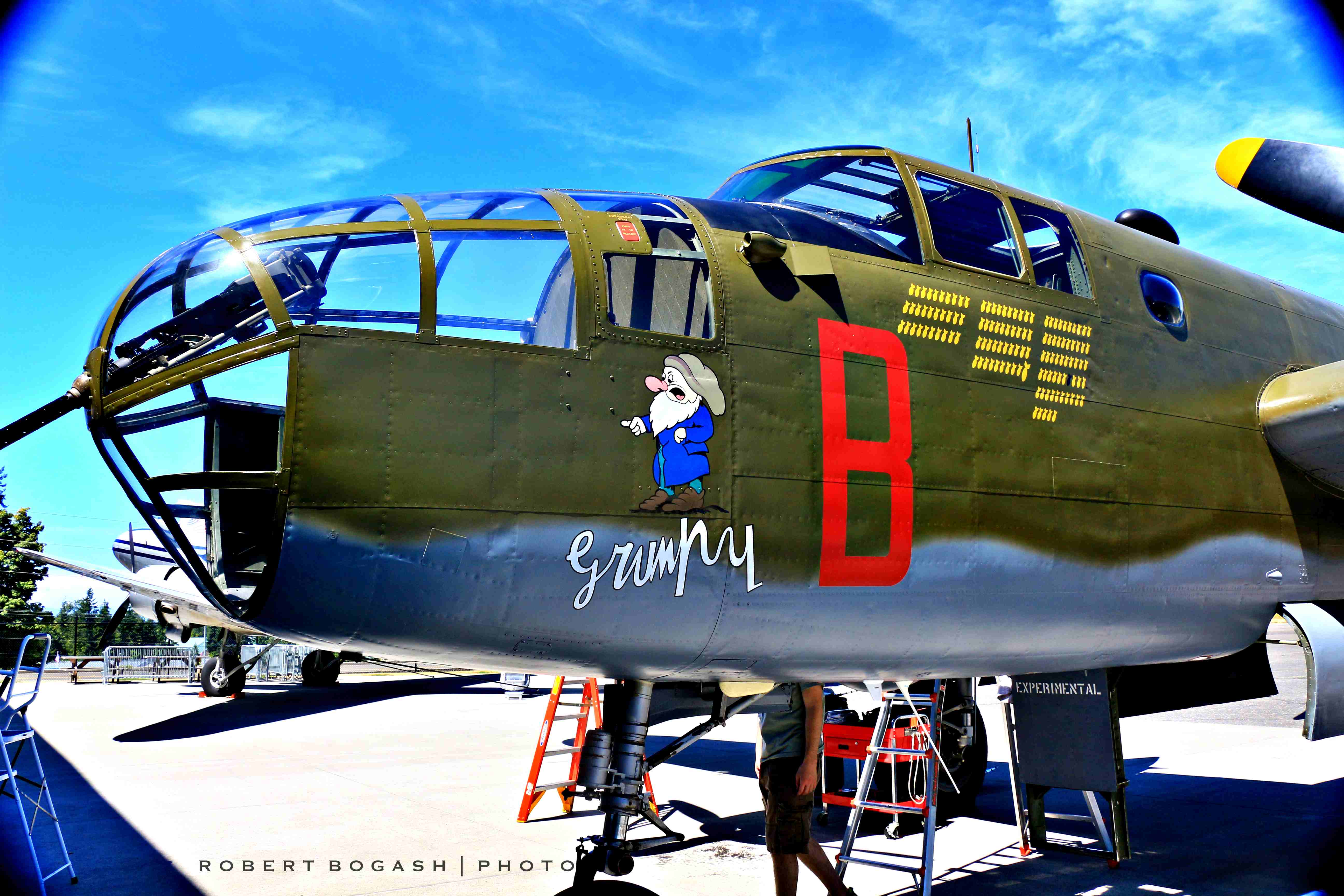
The
North American B-25 Mitchell
The B-25 is the only U.S. military airplane named
after a person.
 Posing with my airplane
at Paine Field
Posing with my airplane
at Paine Field




This story is
reproduced here on my website in my effort to make
interesting stories like this one survive after their
story tellers have passed on so that they may live on in
history.
Back to Home Page
|